
Quench oil purification
An external 20 μm filter loop on the quench tank, running without shutdown, removing carbon black, sludge and debris.
Turbid oil is not a cosmetic problem
Quench oil accumulates three contaminants in service: mechanical debris carried by workpieces, sludge from thermal oxidation and additive breakdown, and carbon black formed during quenching. Suspended in the oil, they change quenching severity.
The vapour-blanket stage lengthens, convective heat transfer degrades, hardness starts to scatter for identical settings, and distortion in thin sections becomes harder to control.
On-line filtration instead of an oil change
A full oil change is expensive, waste disposal is troublesome, and new oil has to re-establish its oxide film and cooling characteristics.
We connect an external filter loop: oil is drawn from the tank, filtered to 20 μm and returned — no shutdown, no formulation change. What leaves is the solid contamination; what stays is the stabilised oil system.
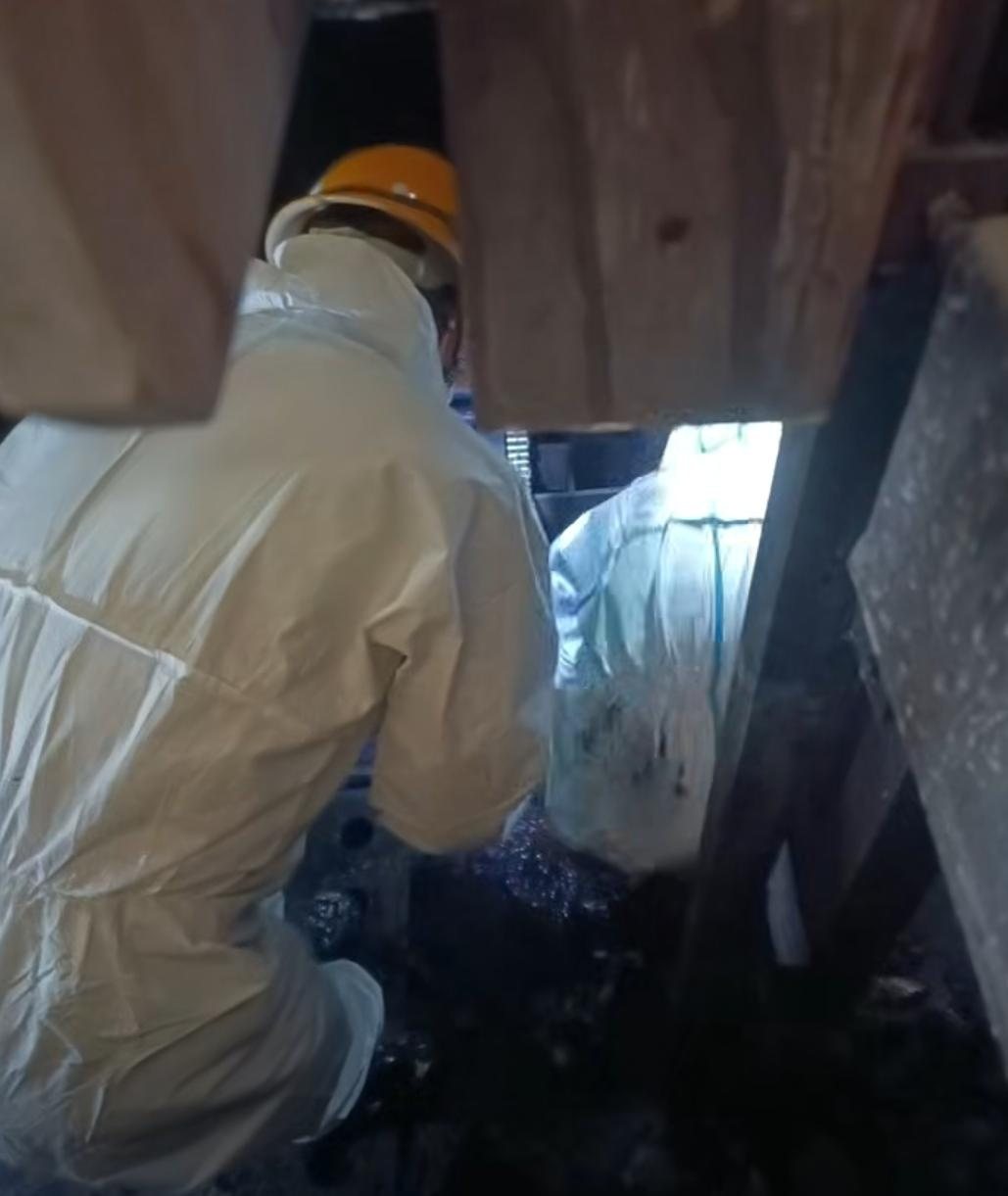
Work at an oil and salt bath
How the job runs
Pre-filtration record
Both parties sample every tank and photograph it, recording appearance, colour and visible contamination.
Connection and circulation
The external unit connects to the tank loop; 20 μm media runs continuously and is replaced as loading rises.
Monitoring
Samples are inspected periodically; circulation continues after clearing so dead zones are also exchanged.
Joint acceptance
A 500 ml glass beaker sample is inspected in good light and signed off by both parties.
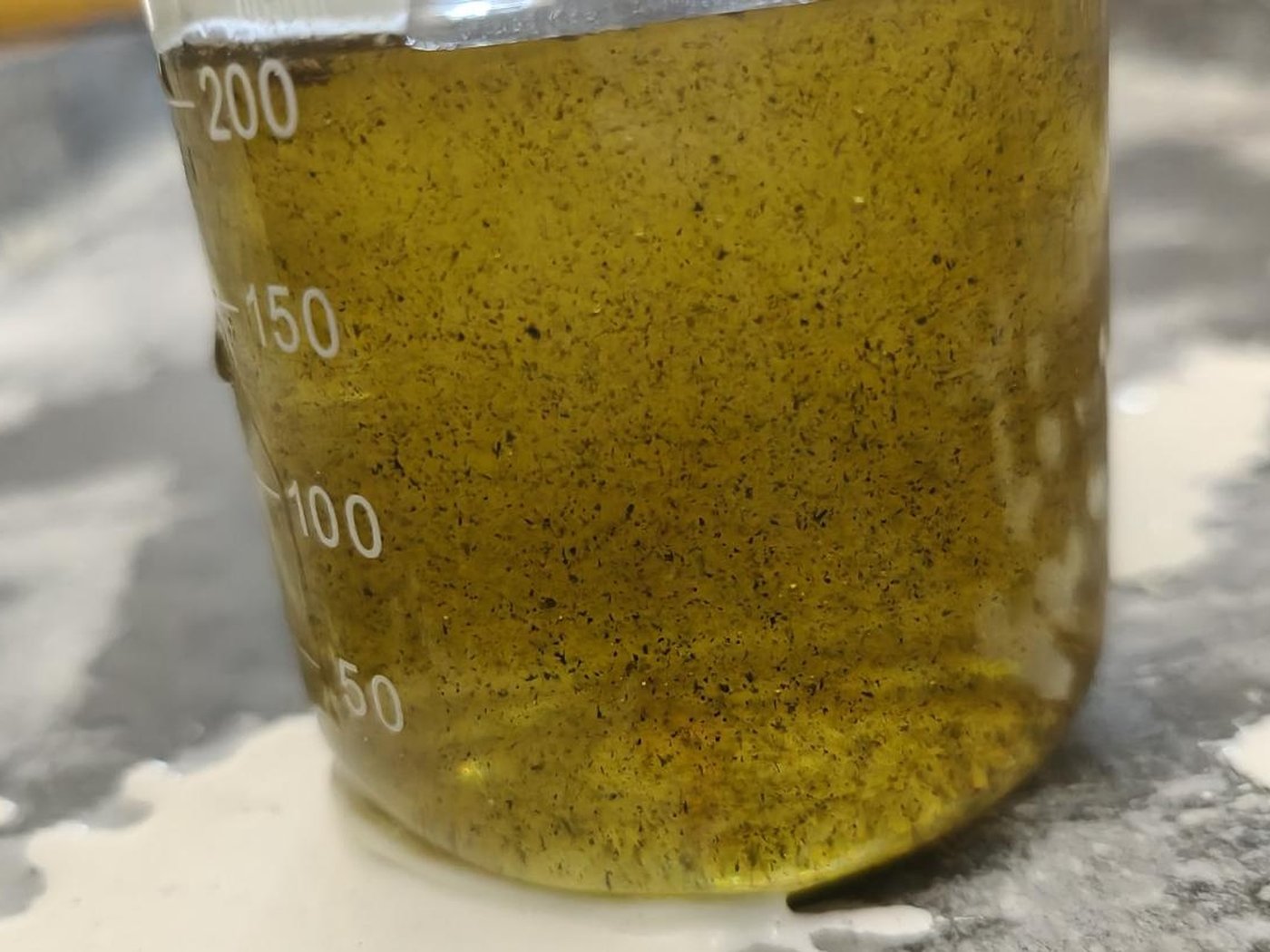
Oil before filtration: suspended carbon black and sludge
Operating parameters
| Method | External unit on the tank loop, on-line |
|---|---|
| Rating | 20 μm |
| Shutdown | Not required |
| Volume | No fixed limit; scheduled by tank volume and contamination |
| Acceptance | Visual check of a 500 ml beaker sample |
| Additional | Oil-tank cleaning (sludge, carbon black and residue removal) |
Filtration addresses mechanical debris, sludge and carbon black only. Emulsification or turbidity caused by water, oxidation or additive precipitation is outside its scope.
Acceptance criteria (contractual)
A 500 ml beaker sample is taken from the filtered tank and inspected in good light:
- No visible particles
- Clear and transparent; no emulsification, turbidity or layering
- Uniform colour (minor deposit at the beaker bottom is acceptable)
- Quality is determined jointly, on site
Will the colour return to new?
Filtration removes solids; it cannot reverse oxidative discolouration. The oil becomes lighter and clearer but will not look new; cooling behaviour improves markedly.
Does it remove water?
No. 20 μm filtration targets solids. If water has caused emulsification, dewatering must come first.
How long does it take?
Scheduled by volume and contamination, typically a few days per tank. Where media cleaning is required, that downtime is excluded from the service period.
Tell us what your bath is doing.
We will tell you what to do next.
One call is enough to establish three things: where your bath stands today, which step comes first, and how long it takes.