
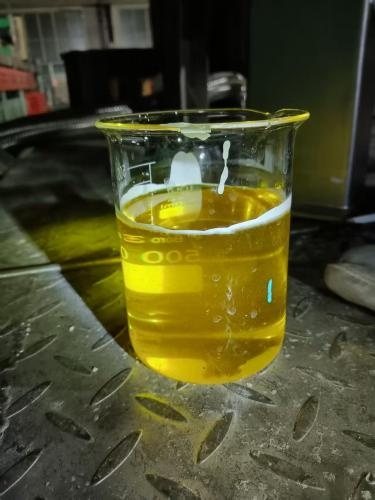
Salt-water concentration control
Buoyancy and temperature measured together, thermal drift cancelled by PLC differencing, water content displayed live and make-up water controlled in a closed loop.
Water is the invisible process parameter
Between 150 and 400 °C a nitrate bath has limited cooling capability. A little water vaporises violently at the workpiece surface, collapsing the vapour blanket and sharply raising high-temperature cooling. How much water is present changes the shape of the cooling curve.
Water cannot stay in hot salt: evaporation, reaction and carry-over remove it continuously. It is not a parameter you set once; it must be replenished.
Why the traditional method lags
Sampling plus gravimetric drying takes 1.3–4 hours. By the time the result exists the bath has changed again — the number describes the salt of several hours ago.
Our approach
Salt density depends on both temperature and water content, in the same direction: hotter salt is less dense, and so is wetter salt. Buoyancy alone cannot separate the two.
The system samples buoyancy and temperature together, looks up the baseline force at the measured temperature, subtracts it, and keeps only the water-driven component. Ten-segment temperature correction, ten-segment indication correction and on-site zero/span calibration then produce the displayed value.
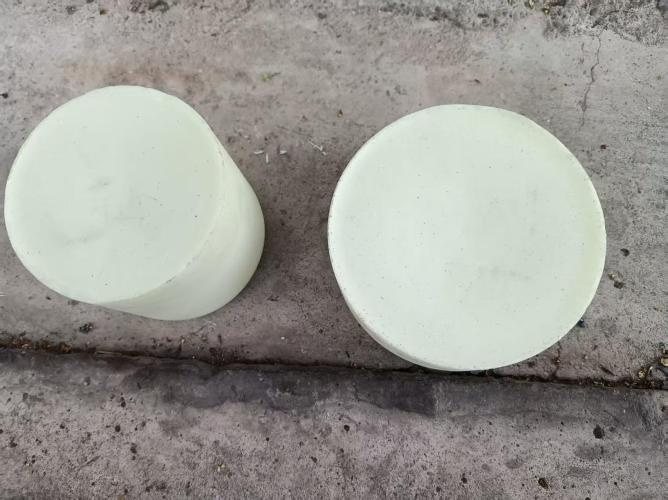
Salt sample after filtration
Five links from signal to make-up
Sense
A float and weight connect through a flexible cable to a load cell outside the bath, so every buoyancy change reaches the sensor; a temperature probe sits in the same layer.
Convert
Both signals are normalised to 0–10 V and zero/span calibrated.
Compute
The PLC differences the signals, removes the temperature component using a ten-segment table, then interpolates the water content.
Act
The value is compared with the setpoint and a PID (or positional) output drives the make-up pump or solenoid.
Record
An HMI displays live values, keeps trend and historical curves, alarms on limits and falls back to a safe state.
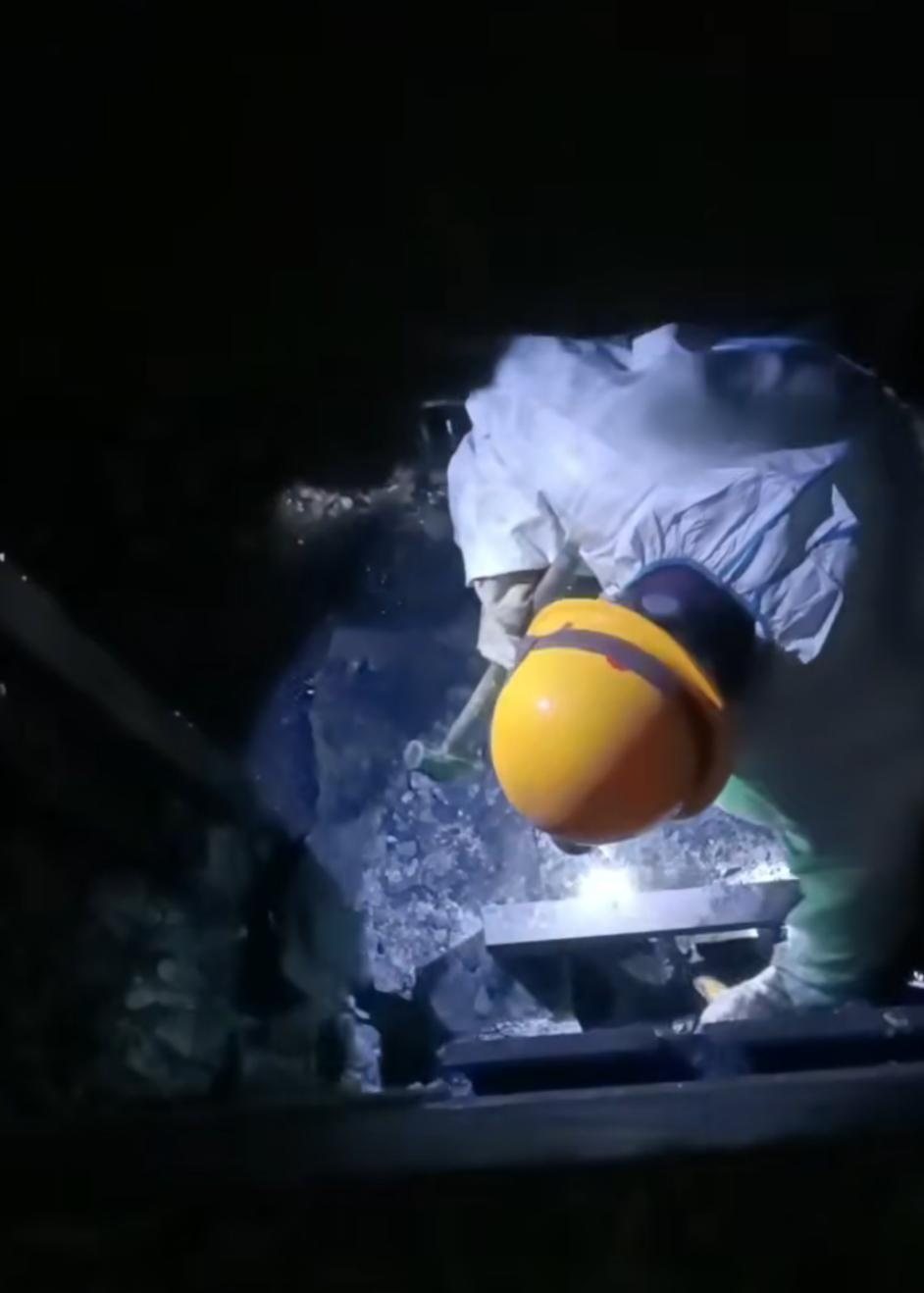
Night-shift sampling
Technical data
| Indication accuracy | ±0.02 % |
|---|---|
| Control accuracy | ±0.05 % |
| Operating temperature | 150–400 °C |
| Water content range | 0–1.5 % (extendable) |
| Signal | 0–10 V input; 4–20 mA or relay output |
| Display | HMI with paperless recording and history |
| Correction | Ten-segment temperature and indication correction |
| Calibration | On-site zero/span, retained in non-volatile memory |
| Communication (optional) | RS485 / Modbus / Ethernet to plant MES |
Typical configuration; the technical agreement after survey prevails. Patent application 2026116812083 accepted.
Delivery and acceptance
Delivery covers installation, calibration and training, with gravimetric cross-checks after calibration.
- Zeroing at a known baseline water content, cancelling weight, float and installation errors
- Span calibration at two or more points, matched to gravimetric results
- Two correction tables generated and retained
- Operator training plus delivered calibration records
Is recalibration needed after a salt change?
Yes. After a salt change, top-up, tank cleaning, float or cable replacement, sensor replacement or overhaul, zero and span should be re-established. The procedure is part of the delivered documents.
Can we have measurement without automatic make-up?
Yes. The system can output values, curves and alarms only, or drive an existing make-up system through 4–20 mA or relay contacts.
Does agitation affect the measurement?
Yes. Agitation makes the float sway, so we add guiding and damping around the float and apply digital filtering in the PLC.
Will salt vapour corrode the electronics?
Sensors and electronics sit above or outside the tank; only the float and cable touch the salt.
Tell us what your bath is doing.
We will tell you what to do next.
One call is enough to establish three things: where your bath stands today, which step comes first, and how long it takes.