
Hardened depth,
judged by the standard
A CHD / SHD testing system built around GB/T 9450-2025 and GB/T 5617-2025 — sampling, preparation, gradient acquisition, interpolated evaluation and non-conformance review.
Why build a testing system at all
A salt bath is a process variable; hardened depth is the outcome you actually sell. Without a repeatable way to measure the outcome, every improvement to the medium is an opinion.
We wrote the testing system for two reasons: to close our own service loop — filtration and concentration control should be judged by hardness results, not by the colour of a beaker — and to give customers documents they can audit.
Two standards, two work instructions
- GB/T 9450-2025 — carburised and carbonitrided case depth (CHD), evaluated from the surface to the 550 HV limit by linear interpolation.
- GB/T 5617-2025 — surface hardened depth (SHD), with the limit hardness derived from the drawing minimum (HL = A × HV, A = 0.8 by default).
Each has its own work instruction, report template, raw record, gradient record sheet and a simplified 8D non-conformance review.
Where the errors actually come from
In practice, most CHD disputes are not caused by the furnace. They come from preparation and layout: edge rounding that displaces the first indent, residual polishing deformation that inflates near-surface hardness, a measurement line that is not perpendicular to the surface, or an indentation pitch too coarse to straddle the limit hardness.
The system therefore fixes three things in writing: minimum distance from the surface (2.5 diagonals), minimum spacing (3 diagonals), and mandatory refinement to 0.05 mm within ±0.15 mm of the limit.
- CHD
- GB/T 9450-2025
Carburised / carbonitrided case depth
- SHD
- GB/T 5617-2025
Surface hardened depth
- Equipment
- Motorised Z-axis micro-Vickers, HV1 (HV0.5 / HV2 by agreement) · MvImage
- System version
- A/0 · effective 2026-03-01
What is inside the system
Work instructions
Sampling, preparation, layout, calculation, judgement
Test reports
Customer-facing templates including interpolated points and basis
Raw records
Per-line results and batch summary
Gradient sheets
Point-by-point d–HV data for dispute traceability
Non-conformance
Simplified 8D with cause, containment and verification
Software guide
MvImage settings shared by both templates
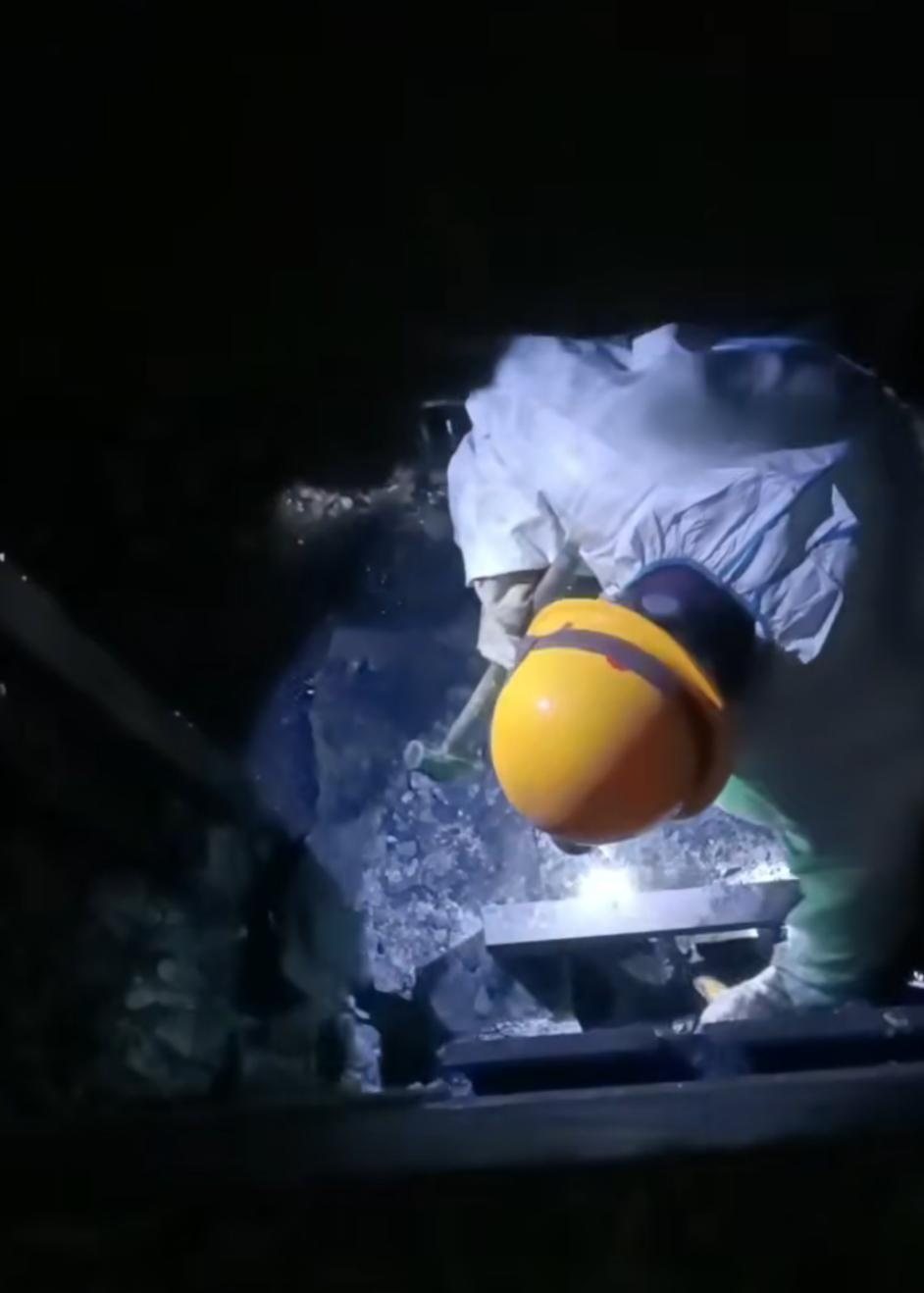
Sampling during a night shift
What this system is — and is not
The system is in internal operation and refinement. It has not applied for laboratory accreditation (CMA / CNAS), and results are not issued as accredited third-party reports.
- Used for internal process control and for customer-witnessed sampling
- Method, records and gradient data can be opened to customer audit
- Where a contractually accredited report is required, we say so before the job starts
Tell us what your bath is doing.
We will tell you what to do next.
One call is enough to establish three things: where your bath stands today, which step comes first, and how long it takes.